Garden of E

---------------------------------------------------------------

My Info

Austin, Texas
I've lived and gardened in urban Austin for the past 8 years, after retiring from the last of my several careers. BR (before retirement), most of my life was spent in colder places like Michigan, Missouri, Oregon, Montana, Alaska, and Boston MA. Best thing I've done AR-- becoming a Master Gardener. Other passions-- Austin Farmers' Market, grandchildren, and travel.

photo by Elsa, age 7

Sunday, February 13, 2011

The dead, wounded, and missing in action

Lo! now the direful monster, whose skin clings

To his strong bones, strides o'er the groaning rocks:

He withers all in silence, and his hand

Unclothes the earth, and freezes up frail life.


- William Blake, Poetical Sketches - Winter, 1783


It's taken a couple of bleak winter weeks (and I hope they're the last this year) to prompt me to post after a long hiatus. Texas gardeners are fond of taking risks with marginally hardy plant, and this year has proved which ones have true mettle. The scene last week didn't look promising.
In my garden some things definitely look dead, such as this no-name euphorbia that once upon a time was upright


and the pretty pine-cone cactus that has lost its oomph.


Another of my favorite succulents looks like it has some real green left; it's not an upright form, so its recumbent state is normal.


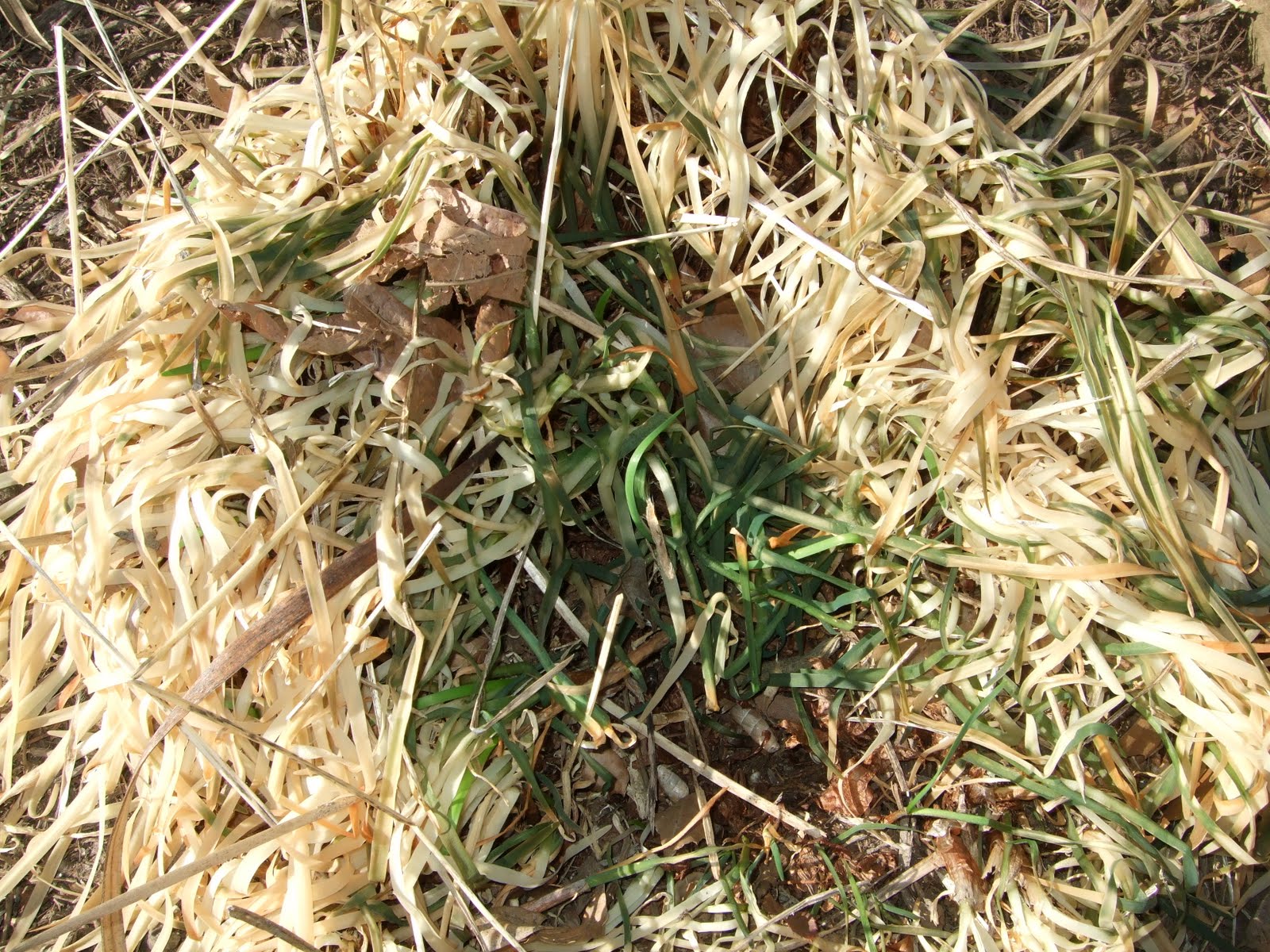
The society garlic, of which I have many, looked like goners, but then I noticed some bright green at the centers.

I was worried that my manfreda undulata "chocolate chips" that I had dug up and divided when it pupped in the fall would be mush, but it looks like the center spike has life.


I saved what little bulbine survived last year's 17 degrees and replanted it. Through that act of natural selection, it looks like it will pull through.


Aloe "lizard lips," my favorite variegated aloe, earns a gold star for being hardy enough to survive two winters without being brought inside.


In the vegetable garden, the more exotic plants in the mesclun mix are toast


and the more common lettuces like Red Sails and Salad Bowl are a little shriveled but still growing.


The sweet bay tree is still green and pretty with its snow frosting. Other things I found healthy and green: lambs' ears, Mexican oregano, both kinds of rosemary, lavender, oregano, and snapdragons.  Those paperwhites that had dared to start blooming lost their heads.


Finally, just so we don't lose our perspective on how our weather contrasts with the east coast, this weather map sent to me by a friend in New Hampshire:

Friday, June 4, 2010

Catching Up (or Gettin' A Round Tuit)

I know it's been months since I posted, and I have no excuse, but it was a cold and dreary winter, and garden-wise there wasn't much going on except for the winter vegetables. The lettuces did spectacularly this year, and I was practically begging neighbors and friends to come and get some.  Here's the final carrot harvest so I could make way for the tomatoes and peppers.
The 'good' days to get out and cut back dead stuff were few and far between--it was either raining or too cold. Okay, whining is over, and spring has come and gone. A lot of time was spent simply cleaning up and looking for what was dead or alive. Alive won.

The agaves did well, except for the ornithobroma, which croaked. Amazingly, the manfreda undulata "Chocolate Chips" had just a few little tip-burns, and on April 6 I found this bloom stalk shooting up. (Note the size of the mullein next to it-more on that later.)

Only 9 days later, it looked like this!
Today it measures 8 feet. YuccaDo says it usually blooms in June, but it popped out last week. More weird than impressive.


Cold weather and rain produced other miracles, such as these profuse 2 year old petunias in March...

iris at least a foot taller than ever before in April...

what had been 3 little lambs ears exploding over the gravel path (I was always told they hate to be wet)...
the best my Jerusalem sage has ever bloomed...

and a spectacular mullein that I didn't know would grow this big, and that I had to remove since it was covering up other plants.


Another little miracle was the pair of Carolina wrens that decided in mid-April to build a nest in this gourd hanging from the back porch rafter.
For 2 weeks the 'dad' bird constantly brought food to 'mom' on the nest.  It became obvious that the eggs had hatched when one day I noticed that both mom and dad were bringing food to the nest--it was so cute to watch them take turns, sometimes both arriving at the same time and one waiting patiently on the fence top while the other one poked bugs into the invisible hungry mouths.  About 2 weeks after the feeding began, both birds one morning became very animated, hopping up and down on the porch railing under the nest and singing loudly as if to say, "Okay kids, it's time to fly."  By this time I had begun to see 1 or 2 little heads peeking out from the nest hole.  After about 20 minutes of encouragement, the first one ventures out but isn't sure if he wants to try it.

His first flight is about 6 feet to the fence.

And within the next 10 minutes all 5 babies had taken wing, with mom and dad following them around the yard anxiously and noisily.  The birds got very used to me and I felt privileged to have been a bird 'auntie.'

Finally, as one who is constantly on the hunt for leaf-footed bugs on my tomatoes, I have to share a discovery with you.  One morning on a pink poppy plant that had grown up in the patio I found adult, juvenile and hatchling leaf-footed bugs and promptly killed them.  A couple of hours later I looked again and there were more hatchlings--same process.  I've probably eliminated about 100 of these bugs on the poppy plant in the last week.  Next year I will plant poppies much closer to where the tomatoes are growing to take advantage of this new-found trap!

Tuesday, November 17, 2009

November Bloom Day

I know, I know, it was yesterday, but I was busy making spaghetti sauce, and then spent the evening eating it, with a Farmers' Market salad and a good chianti.  Besides I wouldn't want to spoil my record of always posting a day late to Carol of May Dreams' invitation to show what's blooming.
A better question might be, "What's not blooming?"  Passionvine and Chiapas sage are all I can think of.

The paperwhite narcissus (against tropical sage) is something I usually enjoy around Christmastime, but this is not a normal year.


Out front, the Fairy rose wrestles for space with plumbago, bulbine, blackfoot daisy, and salvia greggii.


A monarch lights on purple coneflower.


"Kingswood Torch" coleus


The always-reliable cosmos, which has been blooming steadily since April.


The volunteer Gerber daisy


The pigeonberry puts on more color in fall.


Delicate and dainty Cecile Bruner


The very long-lived red, orange, and pink zinnias--remember, Felder Rushing says, "Every color goes with every other color."


Love this pinky-orange.

It's after midnight, late again.

Wednesday, November 11, 2009

Bloggers' road trip

The Austin Garden Bloggers' outing Saturday to San Antonio and other points south has been well documented by now, and a good thing, too, because... after taking just 9 shots, my battery died!  Oh well, here is a partial look at what was a glorious day in beautiful surroundings with a dozen or so affable companions.

The first stop was Madrone Nursery outside of San Marcos where we met the slightly eccentric but very knowledgeable owner, Dan Hosage, who regaled us while we were waiting for the rest of the group with tales of keeping predators from his chickens with something akin to a .44 Magnum.  He has a lot of good natives, especially trees, and maintains that his plants are survivors because he raises them 'tough.'

Next stop, the San Antonio Botanical Garden, 33 delightful acres with a decidely south-of-the-border feel.


Besides the many outdoor themed gardens here, there are four glass-enclosed indoor exhibit spaces:


Alas, the camera died just before we went through the Palm & Cycad Pavilion.  But I did manage to catch the Children's Garden, which was chock full of tomatoes and other veggies and protected by not-so-frightful scarecrows.


We had lunch at the restaurant here on the outdoor patio--I give it 4 stars.  The SABot is now on my list for a spring visit--there is so much to see here.  And we got in free with our LBJ Wildflower Center membership cards!

Last stop was just north of San Antonio at the Antique Rose Emporium.  This location is not as large as the main one at Brenham, but still has huge variety.  The atmosphere here is tranquil and very laid-back, with a most helpful staff.  Three of us came away with a rose I've been drooling over for some time, "Livin' Easy," a floribunda of a color that is hard to describe (Creamsicle?). 

This is what it looks like:

Now to find a place to put it!

Wednesday, October 28, 2009

What I meant to say...

In attempting to clear up what the plant was in Pam's "reds" photo from my garden (see previous post), that looked an awful lot like Japanese maple, I managed to muddle things further by calling it a "red-leaf hydrangea."  I don't think there is such a thing.  It's actually a red-leaf hibiscus.  Sorry about that.


A very happy day

Inside Austin Gardens 2009 will remain a vivid memory for a long time to come. Fantastic weather, appreciative crowds,


kindly comments, cooperative plants (for the most part). My daughter, who comes over a lot, said, “It looks, well… different.” I told her she was missing the hose sprawled on the lawn, the wheel barrow half full of mulch, the shovels and gravel piles that until last week were spoiling the “ambiance.”

It was an altogether fantabulous day, and I have my fellow Master Gardeners to thank for making it so, especially Elaine, the well-organized garden captain, Janelle (everyone loved the plant tags), Rosalie, Holly, Vertie, smart and entertaining speakers Susan and Carolyn, and the many other MGs and interns who made everything run smoothly.


It was so interesting to see what people were drawn to: the Chinese ground orchids (bletilla striata-see previous post) that I got at Home Depot ($3 marked down from $17) after Elaine put me on to them, the gomphrena “Strawberry Fields” that have proliferated from a 4” pot bought 4 years ago and that reseed like crazy, the color combo of them plus the red-leaf hydrangea behind them that Pam caught so nicely in her photo (fooled you Pam, I know it looks like a mini-Japanese maple), the sprightly pigeonberry with its pink flowers and red berries that I had hoped would get noticed, the salvia azurea with its glowing blue blossoms that now is one of my favorites, the blazing red zinnias, the last-minute birdbath of concrete rounds and a handmade bowl (nice photo by Jenny), and the white spiderwort that resembles a starry night in deep shade. Not to mention the manfreda undulata “Chocolate Chips” that some bloggers now covet.

Then there were other things I hope got some attention because they so kindly chose to bloom at just the right time, such as the sweet rose, “The Fairy” next to the sidewalk with its clusters of small , pink blossoms,


and the big indigo spires also spilling over the sidewalk. And I hope people were able to see the new benches full of potted succulents along the driveway fence as they made their way into the back yard.


Oh, if the flame acanthus had just bloomed! The Martha Gonzales roses


are covered with new buds, so drive by next week if you’re in the neighborhood.

Stealing an idea from Randy Case to show "before" pictures, here are a couple from mine in late 2002, the day before I bought the house long-distance based only on these photos:


Strange thing—I spent Saturday evening thinking about all the new things I want to do with my back beds and how much wonderful stuff I saw in the other gardens I can cram into my place by March. I guess it’s a good thing that gardeners never rest on their “laurels.”

Wednesday, October 21, 2009

Now that it's cool...

Working outdoors pretty much every day in the summer from hell left little energy for blogging, so I wimped out until now.  I took only one photo between July and September--no point when there's only rack and ruin and half-finished projects to look at, except for this amazing two-striped walking stick that appeared on the front porch one night in August:

Anisomorpha buprestoide (with male on back)


But then the rains came and with them a second spring.  Wouldn't it be interesting to calculate the rate of plant growth per hour over the first 2 weeks of September.  It seemed I could almost sit and watch things unfurl.

Chinese ground orchid


Passiflora 'Incense'


The storm that hit the Hwy 290-183 area on September 4 brought the schoolhouse lilies on September 6!


And there was a population explosion of anoles--this little guy was barely 1 1/2 inches, sitting on a salvia leaf.


This guy seems to be meditating


The September rains caused a lot of things to bloom before I wanted them to, such as the Souvenir de la Malmaison and Martha Gonzalez roses, and the brugmansia, which went wild up until last week, at times having 10-12 blooms on at the same time.  I do see a couple, though, that look like they'll open by Saturday.


The wonderful little white spiderwort that I got at the MGs' plant sale at Zilker Fest have spread well and will probably still be in bloom on tour day.


Speaking of tour day, it's fast approaching--my nerves are a bit frayed, my arms are covered with mosquito bites, my back is sore, and my cheeks and nose are sunburned, but I've enjoyed every (well, almost every) minute of the preparations.  There's a great sense of satisfaction in seeing ideas come to be.  I am so grateful for the moral support of my gardening friends, not to mention their labor on projects big and small.  The truth is, I could not have done this alone!